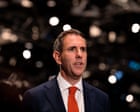
Chalmers notes ‘serious moment for our economy’ but downplays recession fears
The treasurer, Jim Chalmers, has downplayed any fears of an incoming recession while acknowledging it is a “very serious time” for Australia’s economy.
This week, Chalmers presented a special economic statement warning unemployment would climb above 5% alongside slower economic growth for the next two years. He flagged modest cuts in next month’s mid-year budget update, including to the public service.
Chalmers told the ABC’s 7.30 program on Tuesday evening that it had been a “very difficult year” for Australians, which had been reflected in the polls and political commentary:
I take responsibility for the fact that we’re pushing hard reforms through the parliament at the same time as people are under pressure … But I’m not focused on the commentary or the columns in the newspapers. I’m focused on doing the right thing for the right reasons. Not just acknowledging the pressures that people are under, but taking responsibility for responding to them.
Chalmers maintained neither the treasury or reserve bank were forecasting a recession or “expecting our economy to go backwards”, but added:
There are risks and pressures and challenges all around our domestic economy and indeed right around the global economy. This is a very serious moment for our economy.
Wells says meeting with US ambassador ‘really useful’
Anika Wells says she won’t hypothesise what the United States will do, if anything, after the US ambassador raised “objections” to the digital duty of care bill.
As my colleague, Josh Butler, wrote below, the ambassador said vaguely defined harms and penalties will “push platforms to censor lawful speech”.
Wells, speaking to RN Breakfast, says as she did yesterday that the two have spoken and that they’re “ironing out” differences of opinion.
It’s not for me to hypothesise what another nations administration might want to do. I did meet with ambassador [David] Brat yesterday morning. It was our first meeting together. It was really useful.
I think we both understand each other’s positions and we’re ironing out where there are points of difference. Like I said, we won’t take a backward step from protecting Australian kids and helping Australian parents, and they won’t take a backward step from their position.
US ambassador criticises Labor’s digital duty of care bill
The American ambassador to Australia has raised “objections” to Labor’s digital duty of care bill, saying he was “concerned” it would hurt US tech businesses.
“Vaguely defined “harms” backed by penalties of up to 5% of global revenue, will push platforms to censor lawful speech,” David Brat wrote on social media, after a meeting with communications minister Anika Wells.
The bill has not yet passed, but is in the final stages of Senate processes. Wells said she met Brat yesterday, with US tech companies some of the most prominent to be captured by the laws; Wells has previously said Donald Trump’s Truth Social platform would be subject to the laws but that the government had committed to “constructive dialogue” with the US, including during her Tuesday meeting with Brat.
“I think we would say there are points of differences, and we’re ironing them out,” Wells said of her meeting with Brat.
But the US ambassador, posting a photo of that meeting - where both were smiling - wrote online that “free speech is the foundation of a free society, and protecting it is a U.S. priority.”
Today I met Minister for Communications Anika Wells and laid out the Trump Administration’s well-known objections to the Digital Duty of Care Legislation. Vaguely defined “harms,” backed by penalties of up to 5% of global revenue, will push platforms to censor lawful speech.
As Australia’s largest foreign investor, the U.S. is concerned with regulations that impose disproportionate compliance burdens on American companies relative to competitors.
‘On the road to economic ruin’ the new Coalition catch phrase
The Coalition is sharpening its lines and slogans, and trying to get itself into shape for an election as early as next year.
Its smelling blood in the water with Labor and the prime minister’s support sinking.
Angus Taylor, speaking to journalists in the press gallery corridor is keen to use the phrase that the country under Labor is “on the road to economic ruin”.
In five minutes, he uses it four times.
I tell you what’s down though, real wages, incomes, our standard of living, the biggest collapse. The biggest collapse of any developed country in the world. And we’ve got inflation data out today, the expectation is it will be high again.
I think the country is on the road to economic ruin.
Coalition welcomes Solomon Islands dropping China pact
Liberal leader, Angus Taylor, has welcomed Solomon Islands scrapping its pact with Beijing and signing a treaty with Australia - with the leader, Matthew Wale, in Canberra today.
The landmark agreement, signed between Honiara and Beijing in 2022, will not be renewed after the five-year deal expires in April next year.
It was signed in the weeks leading up to the 2022 federal election under the then Morrison government, which Penny Wong called Australia’s “worst foreign policy blunder in the Pacific since the end of World War II”.
Speaking to ABC News Breakfast, Taylor is asked how a Coalition government would stop that happening again. Taylor says the problem was actually Solomon Islands’ leadership at the time:
Well, you do have to nurture these relationships. It’s important. Obviously, it depends on who’s leading, and we have a leader there now who is determined to drop that arrangement. And that is a good thing. We welcome it very much.
Krishani Dhanji here with you for the second-last sitting day of the year.
(The sitting week technically ends tomorrow, but if the government secures an 11th-hour deal on its key bills, it could end up passing them with amendments in the Senate late Thursday and recalling the lower house on Friday.)
As we reported earlier, Solomon Islands’ prime minister, Matthew Wale, is in town today to sign a new treaty with Australia, after it was revealed the Pacific nation would end its security pact with China. Even the opposition was positive about the deal, with Andrew Hastie crediting the government with the “win”.
Inflation data will come out today, something we (and the rest of the country) have been laser focused on, and is likely to be less of a win for Labor. We’ll bring you all the reaction to that too.
I’ve got my coffee, I hope you’ve got yours - let’s get stuck in!
Inflation expected to jump when latest figures released today
The government’s economic management will be back in the spotlight today, with official figures at 11.30am expected to show inflation jumping to 4.8% in the year to October.
That’s well up on the 4.3% annual rate in September, and will be nearly double the Reserve Bank’s official target of 2.5%.
Once again, it’s rising fuel costs that are driving the headline inflation number in the wrong direction.
Nab’s economists reckon fuel costs will contribute 1.2 percentage points to annual inflation, which they predict will be 4.7% (so slightly below the consensus forecast).
The ban of card surcharges from 1 October will also add a bit to price pressures, although how much is unclear.
Only 16% of firms charged surcharges, but there was evidence that the introduction of the ban was used by a wider range of businesses as an excuse to pass on other cost increases to their customers through higher prices.
The RBA will be focused on what is happening to underlying price pressures. The so-called “trimmed mean” inflation measure, which removes the most volatile prices, is expected to bump up to 3.7%, from 3.6%, according to the consensus forecast.
The better news is that analysts believe this should mark a high-water mark for inflation.
“An outcome in line with our forecast would be no comfort to the RBA, but we expect October to mark the peak for headline inflation and to overstate the underlying momentum in trimmed mean,” NAB said.
The best evidence of this is that financial markets are pricing in rate cuts next year.
Chalmers notes ‘serious moment for our economy’ but downplays recession fears
The treasurer, Jim Chalmers, has downplayed any fears of an incoming recession while acknowledging it is a “very serious time” for Australia’s economy.
This week, Chalmers presented a special economic statement warning unemployment would climb above 5% alongside slower economic growth for the next two years. He flagged modest cuts in next month’s mid-year budget update, including to the public service.
Chalmers told the ABC’s 7.30 program on Tuesday evening that it had been a “very difficult year” for Australians, which had been reflected in the polls and political commentary:
I take responsibility for the fact that we’re pushing hard reforms through the parliament at the same time as people are under pressure … But I’m not focused on the commentary or the columns in the newspapers. I’m focused on doing the right thing for the right reasons. Not just acknowledging the pressures that people are under, but taking responsibility for responding to them.
Chalmers maintained neither the treasury or reserve bank were forecasting a recession or “expecting our economy to go backwards”, but added:
There are risks and pressures and challenges all around our domestic economy and indeed right around the global economy. This is a very serious moment for our economy.
Solomon Islands to end China security pact, sign new Australia treaty
Solomon Islands will end its contentious security pact with China, in a major diplomatic win for Australia.
Guardian Australia has confirmed the landmark agreement, signed between Honiara and Beijing in 2022, will not be renewed after the five-year deal expires in April next year.
In a statement, the Solomon Islands government confirmed its prime minister, MatthewWale, will travel to Canberra to sign a treaty with Australia on Wednesday, reported to be worth almost $1bn.
To keep China at bay in the Pacific, the Albanese government has since inked a number of security agreements, including mutual-defence pacts with Fiji and Papua New Guinea.
Good morning and welcome to our live news blog. I’m Martin Farrer with the top overnight stories and then it’ll be Krishani Dhanji with the main action.