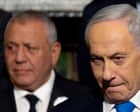
Gadi Eisenkot, the former general who hopes to become Israel’s next prime minister, appears to have distanced himself from forming a unity government with Benjamin Netanyahu following talks between the two rivals.
Eisenkot met Netanyahu, who is fighting for his political survival, to discuss a potential Israeli unity government with a rotation deal for the job of prime minister. Talks took place on Sunday morning, nearly three weeks after the president, Isaac Herzog, tasked Eisenkot with forming a government following inconclusive elections in October.
“The discussion was businesslike, with both sides seeking to bridge the substantial differences between them,” Netanyahu and Eisenkot said in a joint statement, without elaborating.
A source in Eisenkot’s centrist Yashar party told Haaretz that the talks ended because of significant disagreements with Likud, adding that Eisenkot told Netanyahu that he was welcome to join his government once it is established.
The proposal for a unity government with a rotating premiership came from Netanyahu, one day after Eisenkot vowed to announce the formation of Israel’s next government by the official deadline of 6 December, without using the option of a 14-day extension.
Writing on social media on Saturday, Netanyahu said: “My responsibility as a leader requires me to set everything aside … and agree that Gadi Eisenkot will serve first as prime minister, while I will serve as alternate prime minister at the beginning of the term.”
In last month’s elections the pro-Netanyahu forces were reduced to 53 seats, while the four-party bloc led by Eisenkot won 48, leaving both short of a majority in the 120-seat Knesset. Among Eisenkot’s supporters there is strong opposition to working with Arab parties, which made unprecedented gains, winning 19 seats.
Eisenkot, a former general from a working-class background, ran an anti-corruption campaign and denounced Netanyahu, Israel’s longest-serving prime minister, as unfit to serve. He has also condemned a “racist and aggressive campaign of delegitimisation” against Israel’s Arab citizens after Netanyahu accused Arab parties of electoral fraud without evidence.
On Friday Eisenkot accused Likud of stalling coalition talks in an effort to bring about new elections. “Likud … has been unwilling to compromise and, over two weeks, refused to put a single concrete proposal on the table,” Eisenkot said in a statement.
His wide-ranging camp has faced divisions over whether to forge alliances with the ultra-Orthodox parties or the Arab-majority lists, or form a unity government with Likud.
Netanyahu’s opponents scoffed at his offer of a rotating premiership.
Yousef Jabareen, the leader of the Arab-majority Joint List, which is expected to support an Eisenkot-led government without joining it, wrote: “The democratic majority has decided: this bloodstained, neglectful government must go. It is time to fulfil the shared will of the entire public, Jews and Arabs alike, and remove Netanyahu this [coming] week.”
The former premier Yair Lapid, who co-chairs the centrist Beyachad (Together) party, wrote: “Netanyahu’s proposal is yet another transparent con by a serial fraudster who has deceived every partner and violated every agreement.”
Eisenkot’s Yashar party has so far agreed coalition deals with the left-leaning Democrats and the rightwing Yisrael Beiteinu party.
Together, they have a combined total of 36 lawmakers - far short of the 61 needed for a majority in Israel’s 120-seat parliament.
In a potentially significant development on Saturday, Mansour Abbas, the leader of the Arab-Israeli party Ra’am, recognised Hamas as a “terror group”, a move that could pave the way for his party to join a possible Eisenkot-led coalition.
In an interview with Israel’s Channel 12 broadcast on Saturday evening, Abbas discussed a bill that his list co-sponsored to establish an independent commission of inquiry into the security failures that led to Hamas’s 7 October invasion of southern Israel. The bill refers to Hamas as a “terror group”.
Both Ra’am and the Joint List had previously condemned the 7 October attacks as an act of terror. But the statement was seen as significant in Israeli media, as Eisenkot set the designation of Hamas as a terror group as a precondition for joining the government.
Abbas said Ra’am could join a future coalition led by Eisenkot, adding: “The goal is not just to form a government that will replace Netanyahu’s government. The goal is to form a government for four years.”
But some of Eisenkot’s allies have voiced opposition to relying on the support of the Arab-majority lists.
Meanwhile, Britain, France and six other countries issued a joint statement on Saturday calling for postponed Palestinian legislative elections to take place in the first three months of 2027.
The vote was “essential” for a “democratic renewal” in the Palestinian territories and “is inseparable from the preservation of the two-state solution, which we remain steadfastly committed to”, they said.
The other countries behind the joint statement were Canada, Australia, Belgium, Luxembourg, Norway and Poland.
Last month, the Palestinian president, Mahmoud Abbas, postponed legislative elections to September next year. The first legislative elections since 2006, which the international community has strongly advocated for, had been scheduled for 28 November, with a presidential election expected in early 2027.
“Twenty years after the last national election in Palestine”, Palestinians were still being denied “the right to express themselves democratically through the ballot box”, the eight countries said. “The holding of free and transparent elections is essential to preserve the democratic principles that must remain at the heart of Palestinian institutions.”
The ministers also warned that their continued support for the Palestinian Authority went hand in hand with commitments on reform and democratic renewal.
Abbas’s office in October blamed the delay on “obstacles imposed by Israeli measures … as well as the need to create appropriate political, security and on-the-ground conditions”.
Israel rejected any responsibility for the delay.