EU leaders agree on one thing: they're far away from a budget deal
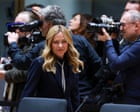
EU leaders are far from reaching a deal on the bloc’s nearly €1.6tn budget proposal for 2028 to 2034, Italian prime minister Giorgia Meloni said.
“We’re light-years away from a solution,” Meloni told reporters before an extraordinary EU summit in Brussels, as reported by Reuters.
“We are not willing to sign off on a budget under which we would have to give more to receive less.”
Spain’s election: the end of a leftwing icon? - podcast
He has become an icon of the European left. A great political survivor, Spain’s Pedro Sánchez has been in power for eight years while - across the continent - the right has been on the march.
The Socialist party leader has championed immigration, stood up to Donald Trump and been a notable voice for Palestinians in Gaza.
But he is not attending the EU summit in Brussels today as he has to focus on domestic politics. On Sunday, Sánchez might be replaced by a conservative government in league with the far right.
Madrid correspondent Sam Jones and European community affairs correspondent Ashifa Kassam report on a pivotal Spanish election, and the gamble that led Sánchez to call it.
Where will this leave the left in Spain, asks Nosheen Iqbal, and across Europe too?
Details of two treaties at heart of UK’s EU reset to be published today
Details of two treaties at the heart of Andy Burnham’s post-Brexit reset plans will be published on Thursday alongside the bill that will implement the changes into UK law.
The treaties signed by the UK and the European Union at last week’s summit will have a 10-year termination clause that would mean if one party were to end the agreement, they would have to pay to rebuild border checks infrastructure, the BBC reported on Thursday.
Any termination clause could bring the longer-term future of the deal into doubt, after the opposition leader, Kemi Badenoch, described it as a “terrible deal” that she would scrap. Nigel Farage has suggested he would refuse to pay, with the Reform UK leader promising to renege on the deal if he were to win power, arguing that Burnham “cannot bind a future British government”.
At a major summit in Brussels last week the UK and EU announced three deals, on food and drink, emissions trading and a youth mobility scheme, which will allow 100,000 young Britons to live, work, study and travel in the EU, with reciprocal access for Europeans in the UK.
Two of the three legal texts will be released on Thursday, covering the food and emissions trading deals, alongside the government’s bill to enact the agreement. The government is also expected to publish assessments of the impact on different sectors and regions of the country .
But uncertainty around the trio of deals remains, with fears they could be derailed in six months unless the UK allows European students to pay domestic-level fees to study at British universities.
Serbia to hold presidential election to choose Vučić’s successor on 27 December
As promised earlier, we also have an update from Serbia, with a confirmation that presidential elections to choose Aleksandar Vučić’s successor will be held on 27 December.
“I call all citizens of Serbia to show responsibility and come out and vote on 27 December,” newly elected parliament speaker Aleksandar Čupić said.
EU leaders agree on one thing: they're far away from a budget deal
EU leaders are far from reaching a deal on the bloc’s nearly €1.6tn budget proposal for 2028 to 2034, Italian prime minister Giorgia Meloni said.
“We’re light-years away from a solution,” Meloni told reporters before an extraordinary EU summit in Brussels, as reported by Reuters.
“We are not willing to sign off on a budget under which we would have to give more to receive less.”
Hungary's Magyar ready for 'long, difficult and sometimes heated' talks during EU summit
Hungary’s Péter Magyar appears to be in good mood and ready for long talks, as he said on his X that he’s ready to stay in the room and drink coffee for as long as needed.
“I expect long, difficult and sometimes heated talks and debates. I’ll be having my coffee strictly inside the meeting room,” he said.
(Could it be a swipe at his predecessor Viktor Orbán, known for occasionally strategically leaving the room during tricky negotiations? Maybe.)
Posting a smiley selfie with Poland’s Donald Tusk, Magyar also noted that fellow EU leaders recorded his volleyball match with Ukraine’s Zelenskyy earlier this week as the pair sought to improve the strained relations between Hungary and Ukraine.
“Many people have asked whether I brought a volleyball. The photos from the friendly match in Beregszász were seen around the world.”
Le Pen slams 'underhanded manoeuvring' to get deal on EU budget ahead of French elections
The meeting is obviously taking place in Brussels, but there are also strong voices coming from way outside the room.
Marine Le Pen,the far-right frontrunner in the French presidential election next year, has blasted “underhanded political manoeuvring” as she described the push to get a deal on the next multiannual budget this year, well ahead of the French vote.
While she backed France’s attempt to increase agricultural funding, she said “the reasons have nothing to do with defending our farmers,” but with rushing the deal before she can get (still onlypotentially) elected in 2027.
“Our country is on the brink of default and social unrest. Our leaders should be working to put it back on its feet rather than trying, through underhanded political manoeuvring, to prevent the French people from expressing their democratic will.”
But AFP noted that while it very much appears to weigh on some minds (10:27, 11:03), other leaders have pushed back at the narrative of a Le Pen-linked deadline, with Austrian chancellor Christian Stocker telling reporters he was “certainly not afraid of an election in France.”
The leaders are now all behind the closed doors as their discussions get under way, with a discussion with the outgoing European Central Bank president Christine Lagarde up first.
Leaders 'very far apart' on budget talks, but supporting remains Ukraine critical, Frederiksen says
The Danish prime minister, Mette Frederiksen, has acknowledged that leaders remain “very far apart,” agreeing with Germany’s Merz that the current proposal is not going to work.
“The budget is too large and not sufficiently future-oriented,” she said, calling for more work on competitiveness, defence and security.
Just like Martin earlier, she noted that 2027 will see “very important political elections across the member state” and openly acknowledged that “the situation within Europe could become even more challenging” as a result, making it important to get a deal this year.
Frederiksen also backed Merz’s call to link the funding for with the new budget, saying Ukraine serves as “Europe’s first line of defence.”
“If Ukraine falls, I believe there is a significant risk … that Russia might push further,” she warned.
She added that “in Europe, we have a tradition of collectively financing our shared expenses, and we must view the funding for Ukraine as part of that.”
Interestingly, she was also asked if the EU would be able to continue this support for Ukraine given several elections in the next 12 months, which could see rightwing and far-right parties come to power in France, Spain and Poland, among others.
She replied candidly that she didn’t know, but strongly “cautioned” against thinking that Europe could simply stop supporting Ukraine and spend the money elsewhere.
“Given everything we are seeing from the Russian side right now … if we let Ukraine fall, we essentially open the door for Russia to advance further,” she said.
Irish PM 'confident' EU and UK will resolve tuition fees disagreement in post-Brexit talks
Irish prime minister Micheál Martin also said he was confident the EU and the EU “will be in a position to resolve the outstanding issue” of tuition fees, as he hailed the deals on sanitary and phytosanitary rules, youth mobility, and energy.
Speaking at the beginning of the European Council meeting in Brussels, Martin said that “for the young people of Britain and the young people of Europe, this is a win-win.”
“I often felt with Brexit that the young people of Britain perhaps were not consulted as strongly in terms of the implications for youth mobility.”
“Young people love to travel, and we don’t need to be placing barriers in the way of young people accessing education, accessing work. In Europe, that should never be the case and I believe we can facilitate that.”
On SPS, he said that it’s “very good news for Ireland and the UK,” as it will “remove barriers” affecting small to medium size companies in particular.
The deal on the ETS also “makes sense,” as “there’s the potential of the UK and being part of the European energy market also offers up opportunities for both sides.”
Martin was perhaps the only leader offering any sort of detailed answer on the EU-UK relations when asked about the hold up caused by the lack of agreement on tuition fees, with most of them just delivering general platitudes.
Czech Republic’s Babiš chuckled and said he thought it was a mistake for Britain to leave, but welcomed its involvement in peace talks on Ukraine, while Latvia’s Kulbergs said he wasn’t across the detail on that issue.
Sweden’s Kristersson also said he was “not into details” on that point, but welcomed “a major step forward” in relations with Britain.
Ireland pushes for EU to consider needs for agricultural spending in next budget
Irish prime minister Micheál Martin also wanted the EU to ensure there is enough money in the budget on agriculture.
He said he raised this issue in talks with the European Council’s António Costa this morning.
“I met with him to this morning, in a bilateral, particularly to press Irish issues and identified the Common Agricultural policies as key concern and that agriculture and agri-food industry is of paramount importance to us.”
But Martin sounded sympathetic towards Costa’s impossible job today, as he needs to “endeavour to reconcile the irreconcilable across the 27 member states.”
But he also makes the clearest reference yet to the worries that are clearly on the minds of many EU leaders, saying:
“But it is very important that we get a budget because if we don’t secure an agreement before the end of the year then I think the prospects of doing it in the first half of 2027 are very dim.”
Yes, that’s almost certainly a reference to the French presidential election early next year.
Merz rejects current budget proposal, doubles down on calls to support Ukraine
Germany’s chancellor Friedrich Merz is ready to push back against proposals already on the table, as he told reporters the current offer “does not provide a basis for reaching an agreement” and doubled down on calls to support Ukraine by the entire bloc.
“The overall volume remains too high,” he said, stressing that “Europe requires sound public finances.”
In terms of Germany’s priorities, he talked about the need to have a prosperous economy and strengthen defence capabilities, which he pointedly said “applies to all of Europe, and it applies to Ukraine.”
He said he was unwilling to opt out for a technical fudge on supporting Ukraine like last year, when three countries opted out from the loan. “I do not see any possibility of repeating that this year,” he said.
“When the European Union provides funding, it does so as the European Union - and that Union consists of 27 member states, not 23 or 24,” he said.
Merz stressed that “we must ensure that Ukraine continues to receive sufficient support in the coming years,” both on military and humanitarian spending.
“We must help [Ukraine] get through a very difficult winter, but we must also assist with its reconstruction,” he stressed.
He called for “constructive” talks with a view of reaching a compromise at some point before the end of the year.
“Yet, I want the overarching framework to be clear: it is in all of our interests that the European Union remains politically capable of action. We are operating in a global environment that requires a sovereign Europe. In my view, this is the most important guiding principle: Europe must remain capable of acting and must become sovereign,” he said.
Bulgaria ready to back EU loan for Ukraine in 'non-military' part
Bulgaria will support a proposed new €45bn EU loan to Ukraine, but only for the part earmarked for non-military aid, prime minister Rumen Radev said.
In a compromise offer to a group of countries objecting to supporting Ukraine’s military financially, the European Commission president, Ursula von der Leyen, stressed last week that the new loan would consist of two parts, a military and civilian one.
It seems to have done the trick for Bulgaria, with Radev declaring he is willing to support the non-military part of the deal.
“Bulgaria is going to take part in the loan of €20bn (for) non-military support for Ukraine,” Radev told reporters as he arrived at an EU summit in Brussels, quoted by Reuters.