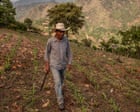
The small plots of farmland in Caparrosa, an Indigenous Maya Ch’orti’ village in eastern Guatemala, are bone dry. It’s mid-June, and the rainy season should have started a month and a half ago, but it’s barely rained at all. The maize is just a few inches tall, and some plots are completely bare.
Lidia Molina is nursing her two-and-a-half-year-old daughter, Karla, sitting on a dusty step next to skinny dogs and chickens. “We haven’t planted our maize yet; it’s too dry,” Molina, 30, said. “We’re hoping it will rain soon, or else we’ll have to make do with whatever my husband sends us.” She is thin and her daughter weighs only 19lb (8.5kg), more typical for a nine-month-old.
The Maya Ch’orti’ have survived centuries of forced displacement and ethnic cleansing by colonial settlers and feudal landowners, maintaining their traditional subsistence way of life despite losing land, water sources, ancestral knowledge and language.
But climate breakdown has pushed them to the brink. Guatemala is one of the top 20 countries most vulnerable to climate change, with two-thirds of the population expected to face water shortages by 2050, according to the United Nations Environmental Program (Unep). Indigenous peoples, who account for nearly half Guatemala’s population of 19 million, are often found in the most remote regions without basic infrastructure such as tap water or irrigation systems. It is these areas that are facing the most severe climate impacts.
In the past 15 years, as erratic rainfall causes subsistence crops to fail, thousands of Guatemalans, many of them Indigenous, are believed to have taken out loans or pawned small plots of ancestral land to fund migration to the United States in hope of finding work to save their families from starvation.
Donald Trump, in his second stint in the White House, has ramped up deportations of migrants, many of whom who had been living and paying taxes in the US for years, severing an economic lifeline for their families back home. Now, as rainfall grows even more unpredictable and dries up regional agricultural labor opportunities, rural communities in Guatemala are running out of options.
Caparrosa, where Molina lives, is located in the ancestral homeland of the Maya Ch’orti’ people, and is one of thousands of tiny rural communities in what is known as the Dry Corridor, a 1,000-mile stretch that covers almost a third of Central America, from southern Mexico to Panama. It’s a spectacular, mountainous and relatively dry area.
For millennia, the dry corridor’s six-month rainy season began in early May, with a relatively dry spell midway through, known as the canicula. Millions of Indigenous and non-Indigenous subsistence farmers timed their plantings - maize, beans and other basic foods - to this seasonal rainfall. Few communities had water capture or irrigation systems.
By the 2000s, the changing climate began to have devastating effects, when heavy rain and flooding caused catastrophic damage in the area. These crisis conditions helped persuade the government to pass its 2013 climate change framework law, making Guatemala the second country in the Americas - after Mexico - to pass explicit climate legislation.
Then came the drought. The rainy season came later and later, and the canicula got longer, hotter and drier.
By 2019, five years of failed harvests had left 1.2 million people in the region needing emergency food aid. Children were dying from malnutrition.
Lidia Molina and her husband, Brian Pérez, are not their real names, which the Guardian is not disclosing, for their security. They were surviving at that time on just a few tortillas each a day, and several of their children showed signs of malnourishment, including distended bellies and hair loss.
The relentless drought triggered the first wave of mass climate displacement from the dry corridor: 188,000 Hondurans and 185,000 Guatemalans traveling in family groups were detained at the US southern border in 2019, an eightfold increase from 2016.
By 2021, the drought had intensified and the situation in Caparrosa was desperate, and so was Pérez.
To escape the worsening drought, Pérez was about to embark on one of the most dangerous migrations in the world with his 10-year-old son Wilson, traveling more than 2,000 miles (3,300km) through Mexico to get to the US border.
To pay his “coyote”, a local guide for informal migration routes, Pérez had handed over the deed to the land where more than a dozen people, the entire extended family, live in a cluster of modest adobe shacks. The land would serve as collateral for a loan to cover the passage, which Pérez hoped to pay off once he found a job in the US.
Fast forward to June 2026. Pérez was not in Caparrosa. Wilson was, and he was 16 by now. The skinny teenager was taller and more solemn and he had a migration nightmare to recount.
The journey across Mexico was really tough, he said, but the US was worse.
Then US president Joe Biden had ostensibly stopped the family separations at the border that surged during Trump’s first term, but that was not the reality Wilson and many others encountered. “They didn’t let us cross, and separated me and my dad,” he told the Guardian.
Biden had also continued enforcing title 42, Trump’s pandemic-era executive order to automatically turn away most asylum seekers without hearing their cases.
Exhausted after a month traveling overland, Pérez and his son Wilson were taken away separately and detained by the US border authorities in a large multi-storey detention center in Texas. Their American dream was over before it had even begun.
“It was really hard [in detention], not much food or water,” Wilson said. “I didn’t see or speak to [my dad] for two months, until they sent us back to Guatemala.”
Since then, his father has been spending long periods away from home, working south of the US border to keep the family from destitution - and to pay back the debt he owes the coyote. He has travelled as far as southern Mexico to work on banana plantations, and sometimes his family don’t know where he is or when he’ll be coming back.
Pérez’s absences mean more responsibility on Wilson to help his grandfather and uncles in the fields when he’s not in school. He held out a large plastic bowl full of maize kernels, saved from last season’s meager crop, ready to plant when it rains again. “It did rain a little a couple of weeks back, but we’d been too busy day laboring for other farmers, so our land wasn’t ready for planting,” said Wilson. “Anyway, we don’t have enough money for fertilizer yet.”
Ironically, synthetic fertilizer is mostly made from the same fossil fuels that, when burned, are the main driver of the greenhouse gas emissions causing global heating - and turbo-charging the drought and erratic rainfall in the Dry Corridor. The cost of synthetic fertilizers has also surged thanks to the illegal wars in Ukraine and Iran.
A week or two later, an update came through from Lidia Molina that Wilson had finally planted the maize after a lightning storm soaked the earth, more than 50 days late. But the rain didn’t last, and not long afterwards they lost the whole crop, Molina said, because the maize was too small and fragile then to endure the canicula.
Yet some communities in the region have found ways to adapt to the changing climate.
In another Ch’orti’ village, Corozal Arriba, just 15 miles north across the mountains from Caparrosa, farming families are producing an abundance of organically farmed fruits and vegetables: tomatoes, eggplant, peppers and potatoes.
Amid the worsening drought, and with no international aid or climate finance or government funding for long-term adaptation measures, the community worked with a grassroots Ch’orti’ organization called Comundich in recent years to build three relatively simple and cheap reservoirs and an irrigation system to pipe in water from a mountain spring. It was a process of trial and error, learning from YouTube videos and local agronomists, but the reservoirs have been a gamechanger: malnutrition and forced migration rates are way down, residents said.
Comundich has helped build almost 20 reservoirs across the territory so far, but there are hundreds of Ch’orti’ villages like Caparrosa where farmers are still 100% dependent on the rain.
Then in late June, just after Wilson planted the maize, which then failed, Pérez got in touch. He was in the United States.
Ten days earlier, he had crossed over the border near the Mexican city of Juárez and its west Texas sister city El Paso, on the other side of the international line that follows the Rio Grande. He had traveled overland for four weeks with 20 or so other Ch’orti’ subsistence farmers, all struggling to support their families. Pérez said that this time he’d used his father’s land as collateral to pay the same coyote, whom he now owes 145,000 quetzales, or almost $20,000.
“I really tried in Guatemala,” Perez said. “And I went to Mexico, working long, hard days in extreme heat in the banana plantations so the coyote wouldn’t take out the house. But you can’t get ahead, and I want more for my family. The weather has changed, it doesn’t rain when it should, and out there it’s just you, the crops and God.”
Droughts, floods, extreme heat, desertification and other climate-related disasters forcibly displaced 250 million people globally over the past decade, the equivalent of 70,000 displacements every day, according to the UN refugee agency. There is no reliable data on how many people from the Dry Corridor have been displaced - internally or across international borders - by climate change. But in the past decade and a half, thousands of poor rural Guatemalans on the frontlines of climate breakdown are believed to have traveled north in hopes of reaching the US.
Under current international law, neither climate change nor famine alone are considered legitimate justifications for claiming asylum.
The US is the biggest historic emitter of the greenhouse gases that cause climate breakdown. It also has a track record of protecting fossil-fuel interests while delaying or blocking action on funding for climate adaptation or reparations being paid by wealthy polluting countries to compensate for climate-driven loss and damage in poor countries like Guatemala.
“Now that I made it to America, little by little I’m going to pay off the debt, and after that the coyote will return the deeds to my mom and dad,” Pérez said. “I’ll only stay until I’ve saved up to make improvements to my house, and then I’ll go back to my family.”
Pérez is aware that the Trump administration is carrying out raids across the US to detain and deport immigrants. He is taking precautions, and rarely goes out except to work as a kitchen hand in a Chinese restaurant, hoping for the best.
Meanwhile, Jorge Cruz, who is from Guayabo, a Ch’orti’ community south-west of Caparrosa, also used his family’s farmland as collateral to head for the US in 2021 and ended up working in construction in Minneapolis. (Cruz is a pseudonym to protect his identity.)
By 2025, he was sending money home to his wife every two weeks and slowly paying off the debt he owed the coyote.
But early one morning last September, he and a colleague were surrounded by ICE trucks after stopping at a gas station to buy coffee and breakfast sandwiches before work. Cruz was arrested, and spent 70 days in an ICE detention center in Wisconsin, before being deported back to Guatemala wearing the same clothes he’d had on that day in September. He lost all his belongings, including the keyboard and guitar he played in the church band, he said.
About a third of Guatemalans put on deportation flights in 2025 had been employed in construction, according to the Guatemalan Institute of Migration, with others working as pilots, accountants, house painters, farmers, mechanics, electricians and waiters, and a whole host of other professions that contributed to the US economy. They were paying US taxes and sending billions of dollars to the Guatemalan economy through remittances.
Trump’s mass deportation campaign shows no sign of abating, despite the drubbing by Democrats in the midterm elections and his anti-immigration tactics being a factor in turning voters against the Republicans.
Still, Pérez, in the United States, is hopeful. In mid-November, he said he had just finished paying off his debts and could now start saving to build a decent house in Caparrosa.
“It’s not easy, but if I keep my head down I think I’ll be fine. It’s a risk, but Wilson is grown now. If something happens to me, he will look after his siblings.”
Cruz, however, speaking to the Guardian in Guatemala City, where he found work in construction after being deported back to Guayabo, said: “I felt like crying when they sent me back with nothing, without having achieved my goal to provide for my children and build a better house.” He added: “But I still have that American dream.”
In the past, deportees would try to reach the US again, but the current immigration crackdown is so cruel that Cruz said, for now, returning feels too risky.
His family home, like most in Guayabo, consists of a couple of simple dusty adobe rooms, with an outdoor toilet, kitchen and sink with tap water a couple of days a week. There are a few bigger, more western-style houses that belong to neighbors with relatives who made it in the US.
For Cruz, like Pérez and most other Guatemalan climate migrants, the expensive and dangerous trek to the US wasn’t a first, second or even third choice. Speaking outside his workplace in Guatemala City, Cruz said he hadn’t finished paying back the loan for his journey, and the coyote still had two land deeds, one for a half-acre plot that Cruz bought after years of working in the sugar plantations. The other is an acre plot owned by his father, Don Clementino, that had once belonged to his grandfather.
“It worries me that the coyote could come here at any time,” Don Clementino said at his home in Guayabo. “That one acre is where I plant corn and beans for the family. The climate isn’t the same any more, so it doesn’t yield much of a harvest, but that’s the only land I have to leave to my children.”
Guayabo is rockier than Caparrosa and particularly arid, with few natural springs and limited access to clean water for drinking, cooking and hygiene. Parasites and other gastrointestinal diseases are common, as are worms and insects that burrow into the skin.
Forced migration is the norm. Historically, a lot of men and boys from Guayabo would spend six months a year working in the sugar cane fields on the Pacific coast. Others have crossed the border to Honduras for the coffee harvest. Both crops involve backbreaking work for low wages, which is relied upon by many Indigenous Guatemalans, who have the highest rates of poverty and child malnutrition in Latin America, according to Unicef.
Mario Ramírez, 58, also of Guayabo, has traveled to Honduras each year to harvest coffee since he was just 11. Back then, the going rate was half a quetzal (50 cents) for every box of coffee beans harvested, a rate that has risen gradually to 20 quetzales ($3).
“The pay is better now, but there’s no coffee to pick because of the weather. The rains have changed,” Ramírez said.
Like subsistence farming, these commodity crops are on the decline due to climate change. And with migration to the United States growing more difficult, the people of Guayabo are left with few options.
Guatemala is suffering far more extreme weather events, drought, floods, and higher temperatures, while the latest El Niño cycle is expected to be punishing. Yet the average rainfall nationally hasn’t really changed over the past few decades. According to Edwin Castellanos, Guatemala’s vice-minister of natural resources and climate change, this presents opportunities.
“The problem is water distribution, and the solution is storage, which isn’t expensive,” Castellanos said. “The ministry of agriculture has programs to promote water storage and irrigation, but the challenge is reaching thousands of farmers. Guatemala is a small country, and we don’t have sufficient resources or personnel.”
Rodimiro Castillo, founder of the grassroots Maya Ch’orti’ group Comundich, believes that the Dry Corridor can be productive and provide a dignified life for the Ch’orti’ people. But only if the approach to adaptation is more radical and begins to address some of the historical injustices dating back to land seizures and ethnic cleansing by colonial settlers and the military dictatorship, which has left large swathes of ancestral Ch’orti’ territory in the hands of private landowners.
“There is water, but it is not in the hands of those who need it, it is in the hands of those who seized it,” said Castillo. “So we are trying to break this narrative that life is not possible in our territory, the Dry Corridor. It is possible.”
The improvised irrigation system in Corozal was proof of concept for Comundich, which is now pitching project ideas to the government and international aid agencies, pushing for more focus on long-term sustainable adaptation measures rather than short-term handouts.
“It changed everything for us,” Elsa Calderón , a subsistence and community organizer in Corozal, said of the reservoir system. “There used to be a lot of malnourished elderly people and children. Some were so terribly thin that they died [but] this hardly happens any more, we grow enough vegetables to eat and sell some at the market.
“We want to build another bigger reservoir,” she told me, “so there’s enough water for our maize and beans, too. That’s our vision.”
Developing countries need an estimated $305bn a year for adaptation projects such as coastal restoration, reforestation, and rainwater capture, storage and irrigation systems for small-scale farmers, according to the latest analysis from Unep. However, there was less than a 10th of this in public finance available from the wealthiest and most-polluting nations for developing countries in 2024.
“People want to remain on their land. They don’t want to be taken to the moon or to Europe, despite the destruction the Global North is causing,” said Adrián Martínez, director of La Ruta del Clima, a climate justice organization based in Costa Rica. “But the scale and timelines for finance are wildly out of step with how urgent the situation is.”
Without a massive injection of international finance now, Castellanos believes that parts of the Dry Corridor will become so arid that adaptation measures will become prohibitively expensive, and farming impossible.
Living off the land is so deep for the Maya Ch’orti’ people, it’s part of who they are, physically and spiritually, and they aren’t willing to accept displacement from their ancestral territory as a fait accompli because of the climate destruction wreaked by others.
Comundich’s Castillo said the communities need the resources and aid agencies to “get out of the way” while they put the resources to best use for future sustainability.
“We want to return to our cosmological vision, to our relationship with nature, to collective strength,” Castillo said. “We have deep roots in the land and in Mother Earth. After all, we are the original people of this place.”