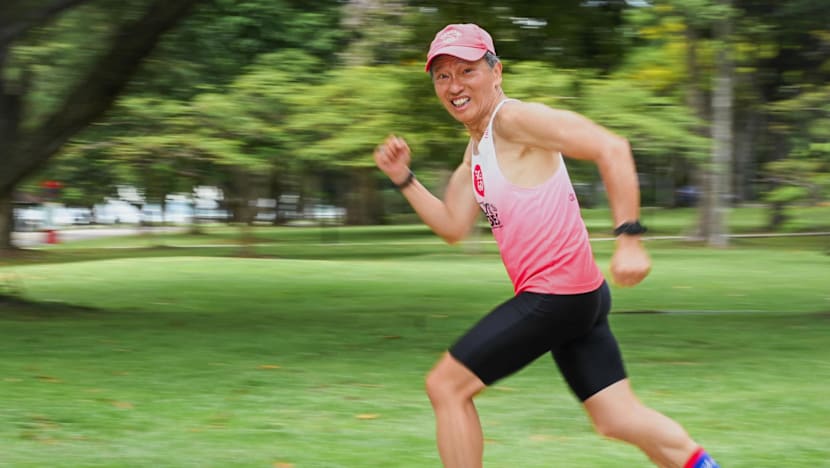
What does retirement look like for this 68-year-old? Running, cycling and mountain climbing fill his days
Staying fit has given Mr Neoh Kean Chye more than physical strength - it has helped him maintain his independence, make friends and stave off loneliness.
When I first met 68-year-old Neoh Kean Chye at a cafe at East Coast Park, it was slightly before 10am on a Thursday and he had just run about 300m from the nearest bus stop so he wouldn't be late.
Looking lean and lively, the retiree did not seem at all out of breath.
As we prepared to film the interview outdoors, Mr Neoh kept himself busy helping to arrange the chairs. And when it began to drizzle, he ran back and forth to shift the camera equipment indoors.
Never still for a moment, he moved in a way that even some of my peers in their 30s would find hard to match.
I caught myself instinctively thinking: If I have the privilege of reaching that age, I want to be just like him.
The spring in his step and his nimble movements come less from good genes and more from his active lifestyle.
Mr Neoh's exercise routine consists of running distances up to 10km twice a week, cycling daily and stair climbing on the weekends.
But he was not always this active. When he was much younger, he led a much more sedentary lifestyle.
It was in 2019, when Mr Neoh retired from his job as a senior quantity surveyor in a construction firm, that he made a switch from a more relaxed lifestyle to an action-packed one.
In his own words, at 61, he became "alive" again.
Before that, leisure time was limited, with long hours spent tendering new construction projects and on the laborious administrative work of managing his company's cash flow.
"It was a matter of firefighting to get work done ... Hence, weekdays were strictly work and whatever limited time left was for family," he said.
"I was bogged down by my work but within me, there was a strong urge to do many things - things that I'm doing now," he said.
Travel was also rare and he usually just had time to plan a yearly trip to his hometown in Penang, Malaysia. He moved to Singapore to study at the National University of Singapore and later became a naturalised Singaporean after his daughter was born.
"When I retired in 2019, I found that I could start going for (overseas) tours, for hikes, and do all sorts of things that I wanted to do, which I couldn't do when I was working," he said.
Apart from finally pursuing the activities he had long wanted to try, his other motivation for being active stemmed from a desire to remain independent and be less of a burden to his wife and his 33-year-old daughter as he aged.
He said that he knows of siblings who have argued and fallen out when it came time to take care of aged and sick parents.
"I won't want to see myself in that situation 10 years or 20 years in the future," he added. "Hopefully, by keeping active, the number of years spent bedridden will be lessened."
But his newfound freedom came at an inopportune time, with the COVID-19 pandemic hitting shortly after his retirement began.
With the borders closed, Mr Neoh ran and cycled regularly around his home in Bedok to build up his fitness.
Then, once travel restrictions were eased, he was ready for the overseas adventures he had long envisioned.
He signed up for vertical marathons, where participants climb up the stairs of skyscrapers as quickly as possible.
In Malaysia, he scaled the 68-floor Komtar Tower in Penang and the 49-floor Berjaya Times Square in Kuala Lumpur. In Singapore, he took on the 65-floor Guoco Tower in Tanjong Pagar.
He also began joining and organising overseas mountain hikes in 2022. His first hike, to Gunung Lambak, an isolated hill in Malaysia, was organised by a friend.
Since then, he has been hooked.
His hikes have taken him to Mount Kinabalu in Malaysia, Annapurna Base Camp in Nepal, as well as Mount Andong, Mount Prau and Mount Merbabu in Central Java, Indonesia.
Closer to home, he has also made about 20 hiking trips to mountains and hills in Johor Bahru, Malaysia.
He also ran his first half-marathon last year at the Standard Chartered Singapore Marathon and finished in a time of two hours and 39 minutes, a smidge faster than the average finishing time of two hours and 40 minutes.
Mr Neoh is grateful that he remains fit enough to take on these physically demanding adventures.
"Being able to move about independently is a blessing in itself, as I realise what good a healthy body can do for me in return," he said.
KNOWING HIS LIMITS, AND RESPECTING THEM
I have interviewed many athletes and high-achieving individuals with "Type A" traits - highly ambitious, competitive and driven. Hearing Mr Neoh list all that he has done, I expected him to be similar.
Yet, he turned out to be nothing like that. He takes a surprisingly conservative approach to any activity he does.
"I try to do as many different types of activities as possible, but I feel that there is a limit to what I can do," he said.
"For mountain climbing, there are elevations I can manage, but there are heights that are definitely not doable for me."
For instance, although he has trekked to Annapurna Base Camp in central Nepal, which is 4,130m above sea level, he is cautious about venturing above that height.
"If you ask me to push it to 5,000m or 6,000m, I will think twice, because you need a lot of dedication, training and good nutrition, and also the preparation to achieve the summit," he said.
Mr Neoh believes that seniors such as himself can be more active, but said it is important to recognise age-related limits and avoid pushing themselves to the point of recklessness.
He gave the example of his vertical marathons. Once, he took just 14 minutes to climb 68 floors of the Komtar building in Penang.
It might sound impressive to the average person, but Mr Neoh was quick to point out that the winner had completed the climb in about half the time.
"(The winner) is half my age ... So when you look at it in that context, there has to be some recognition of my limits," he said.
Although many serious runners would pride themselves in keeping to a routine and not skipping any runs, Mr Neoh listens closely to his body.
"Normally, after a run, if I can feel the ache in my body or legs, I will take two or three days to rest," he said.
It is foolhardy trying to push the limits. And running while in a state of fatigue could have more lasting consequences.
"There may be a breaking point … I don't want to go for a complete rest for one month to get over a ligament tear or whatever."
He also said that within the run clubs he has joined, he has seen cases of younger members in their 40s and 50s who trained too hard for marathons and got sidelined for months due to injury.
"It's not advisable to follow their tempo."
When asked if he had any medals to show for all the competitions he's joined or whether he keeps track of his personal timings, Mr Neoh said that he was not concerned about such measures of performance.
Above all, he is simply happy to stay active, rather than the results that he gets.
"When I exercise, I feel happier," he said. "The motivation is to keep healthy, and that's what keeps me feeling good."
PREPARATION AND HEALTHY HABITS
Beyond judging his limits, Mr Neoh said that staying active has also come down to maintaining healthy habits.
He credited his cautious approach and what he calls "good genes" for keeping him injury-free in the seven years since his retirement, an enviable feat even among athletes decades his junior.
He rarely drinks alcohol, and every morning, he prepares a bowl of fruit - bananas are his favourite - for himself and his family without fail. He also cooks at home most of the time rather than eating out.
"I enjoy cooking because I can cook whatever I want and make sure that it is not too salty or oily compared to food bought elsewhere," he said.
He is equally meticulous about preparing for his adventures.
For instance, in the lead-up to his latest hike to Huangshan, or the Yellow Mountains, in China's Anhui province, he spent a month researching the routes and planning where he and his friends would stay.
He excitedly showed me a large map of the entire mountain range, pointing out the different cable cars he had to take to access each hiking location, and each hiking trail he had completed during his two-week trip in November.
"I have to think seriously about the preparation, the gear I'm going to take along, and the nutrition," he said. "All of that is very important because without proper preparation, I don't think I'll enjoy the hike."
This level of preparation extends to his other activities. He dedicated three months of incremental training before he ran the half marathon here last year.
Although wary of venturing above 5,000m, he hopes to make one exception: Mount Everest Base Camp, a portion of which lies 5,150m above sea level. He wants to complete the trek before turning 70.
He expects it to be "very challenging", requiring months of physical conditioning and specialised cold-weather gear.
"I believe that by age 70, the bodily strength and stamina may not be that good, and I don't want to be a danger to the group members that I hike with in case of an emergency," he said.
Keeping active has also helped Mr Neoh stave off loneliness.
He has made friends across different age groups through the activities he takes part in, from running sessions and vertical climbs to the hiking trips he organises.
He is also part of several hiking interest groups on Facebook, and has found it easy to introduce himself to strangers.
"If you are open-minded and friendly, you can talk to anybody. There's no hindrance," he said.
Mr Neoh also joined the Antica Foundation last year, a non-profit in Singapore that promotes active ageing, among other aims. He has taken part in programmes such as training for runners and seminars on injury prevention.
Through his interest groups and the Antica community, he enjoys sharing stories about his travels, exercise routine and personal milestones.
"These are the things I enjoy, and I'm proud to share with the people around me," he said. "My main aim is to encourage seniors to be active."
Mr Neoh hopes to stay active himself for as long as he can, because he feels "very uneasy staying at home and doing nothing".
When he retired at 61, he set himself a goal of accomplishing everything he wanted to before turning 70 - an age by which he had assumed his body would no longer be able to keep up with the active lifestyle he had embraced.
Now, having achieved all that he set out to do, he no longer sees 70 as a hard limit, and will only stop his current level of activity if he becomes bedridden or incapacitated in some way.
"I think I may have arbitrarily set a cut-off time, but knowing myself, I may remove it."